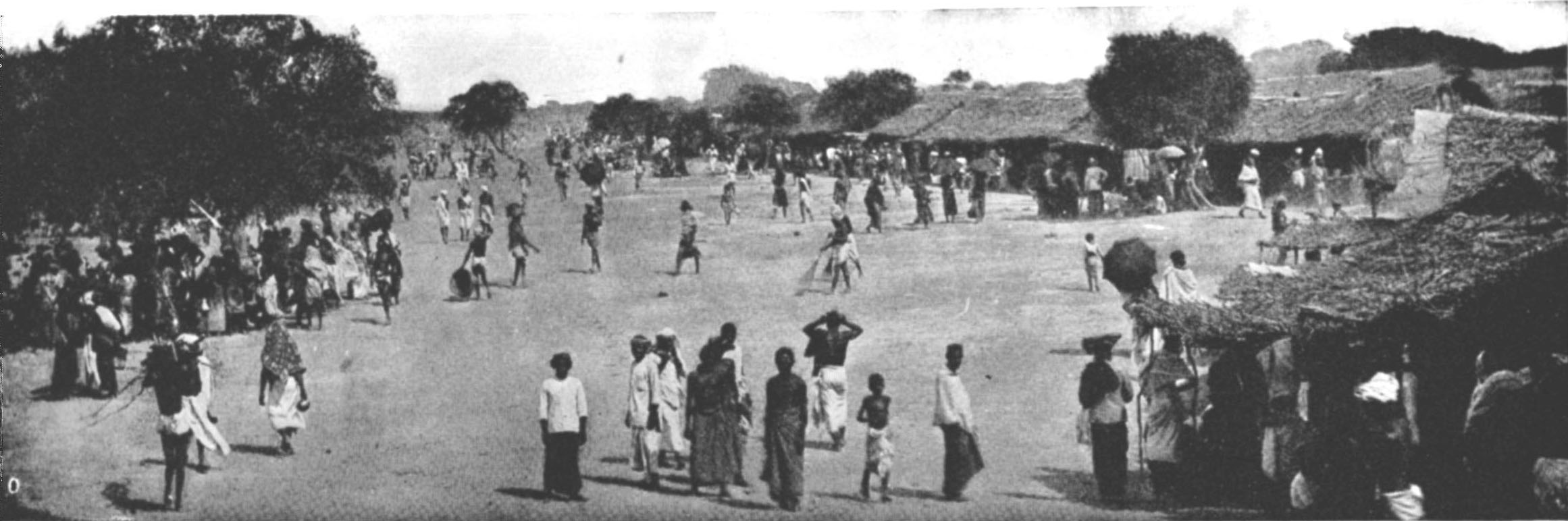
WHICH SPRINGS UP IN A FEW DAYS
Ceylon has long been celebrated for its sapphires, rubies, cat's-eyes, moonstones, opals, amethysts, carbuncles, and emeralds; but none of these, nor all of them combined, have given to the island the fame and the romantic setting that have been conferred on it by the product of the limpid waters that bathe its coral strands and sandy. beaches. The poetic name of Ceylon today is "The Pearl on India's Brow."
Colombo, the principal city of modern Ceylon, is a stopping place for all the steamers plying between Europe. and Asia and Australia, and is therefore visited by thousands of tourists and travelers each year. But the pearl fishery is so remote from Colombo that not one visitor in ten thousand ever goes there.
In Colombo a person sees only a fraction of the great pearl crop, of which more than 90 per cent-99 per cent in some years goes to India ; but this fraction is sufficiently seductive to the transient visitor to render uncertain the time and manner of his arrival home, for the pearl shops in Colombo are veritable magnets that irresistibly attract the contents of purse and wallet.
From the most remote period of which there is any record, it would appear that the pearl fishery played a very important part in the history of Ceylon, having had more or less direct and intimate relations with every important aspect of the civilization of the island. The information available clearly suggests that from the earliest times the fishery was conducted in much the same way as in our own day the same methods of obtaining the pearl oysters, of handling the catch on shore, and of extracting the pearls.
In the words of a local writer, "Ceylon is a place with a glorious past. Its once magnificent cities are now .but a mass of crumbled and half-buried ruins ; its native dynasty has passed away forever; one institution alone has descended to us unchanged by the vicissitudes of 3,000 years the pearl fishery."
In medieval times there was a very considerable literature of the Ceylon pearls and pearl fishery. In addition to frequent references in Arabic and Persian records of the eighth to eleventh centuries, the accounts of various European travelers (one of whom was Marco Polo, 1291) have come down to us and given glimpses that show how similar were the conditions then and now. The modern history of the pearl fishery, especially under British rule, has been most elaborately recorded.
There are pearl oysters and pearl oysters. There are the huge thick-shelled species of the South Seas, Australia, Philippines, and Burma, that are as large as dinner plates and weigh 3 to 4 pounds as they come from the water ; there are the small, thin-shelled forms of Venezuela, Japan, Persia, and Ceylon, that are only a few inches in diameter and weigh only a few ounces.
The large pearl oysters produce the mother-of-pearl of commerce, which is so valuable that the fishery is profitable even when no pearls are obtained. The smaller mollusks have little value except for the pearls they yield.
The maximum size attained by the Ceylon pearl oyster is only 4 inches, and the shells are so thin that they may be crushed between the fingers of an average man.
The pearl oysters are more or less concentrated on banks, which occupy a shallow, level plateau, extending from the shore for a distance of 3 miles in the southern section to 20 miles in the northern and broadest part of the gulf. This plateau is bounded by the 10 or 12 fathom curve, and falls away quite abruptly, so that within a very short distance of the fishing grounds we may get soundings of 100 fathoms, or even 1,000 fathoms. The area of the pearling grounds is about 800 square miles. The bottom is for the most part sand, diversified by outcroppings of calcareous rocks. which form flat or slightly inclined ledges, on which the pearl oysters grow. Aggregations of ledges_constitute "paars," or banks, which centuries ago received names that are still applied.
The largest and most important of these grounds is Cheval Paar, lying from 9 to 13 miles offshore at a depth of 5 to 8½ fathoms, and extending about 6½ miles from north to south and 4½ miles from east to west.
It is a matter of record that during the 19th century there were only 36 year when fishing was possible. Mentioning only the longer periods of cessation, it may be noted that there were no fisheries in the years 1821 to 1828, in 1838 to 1854, in 1864 to 1873, and in 1892 to 1900.
It was this last long series of recurring failures that induced the Ceylon government to secure the services of an eminent English biologist for a comprehensive investigation of the pearl-oyster grounds and of the causes for the disastrous failures. The result was that a great deal was made .known concerning the conditions of life of the pearl oyster, and for the first time information was afforded the government by which the industry might be placed on a stable basis. Forthwith, in spite of a vigorous protest, the government leased the pearl fishery, to a private syndicate and retired from the business from which it had been obtaining a large but not steady income.
The numbers of oysters produced are absolutely beyond comprehension. A few years ago, on one paar five miles long and two miles wide, small pearl oysters were ascertained to be present to the number of 10,000 per square yard, in places forming a layer over the bottom nine inches deep ; one diver, who was down only 30 seconds, brought up 3,225 young oysters by actual count. This condition of the grounds was determined in November by government inspectors ; in December of the same year no oysters whatever were found all had disappeared as if by magic. On another bank, known as the Periya Paar, scientific experts in the year 1902 estimated the number of young oysters at one hundred thousand million, but so insecure was their existence that on inspection a few months later it was found that all had been swept away.
This destruction is due to a variety of muses, but principally to two : physical agencies, such as the burying of the oysters by sand, which are ordinarily responsible for only 4 to 5 per cent of the mortality ; and animals, particularly fishes, of which various kinds and sizes feed largely on the pearl oysters, and are so charged with fully 90 per cent of all the losses to which the young and full-grown mollusks are subject.
Trigger-fishes, sting-rays, and other species with powerful jaws and strong digestive powers frequent the pearling grounds in hordes and find the pearl oysters entirely to their liking. Suggestions for protecting the grounds from the ravages of fishes have been made at different times. No practicable remedy has been offered, however ; and, even if there were, there might be a potent reason for not applying it in the fact that this destruction of oysters by fishes is a step and an essential one in the formation of pearls.
The preliminary inspection of the oyster beds on which it is proposed to permit the divers to work is for the purpose (1) of ascertaining the approximate number of pearl oysters that may be taken, (2) of marking the areas on which fishing is to be allowed, (3) of specifying the number of boats on each area and the number of days that are to be devoted to the fishery, and (4) of making an official valuation of the prospective pearls in order that the fishery may 'be advertised'.
The official examination of the oyster grounds immediately before a fishery is one of the most interesting features of this great industry. The inspector anchors his boat in the center of what is regarded as a typical area, and is attended by four smaller boats each containing three divers. These boats are rowed in concentric circles about the central vessel, and at intervals the divers are sent down with instructions to bring up every mature oyster they can collect in each dive. This work continues until 12 circles the outer 1½ miles in diameter have been run about the anchored boat and about 325 sample lots of oysters brought up.
The area covered by oysters being computed in square yards, the approximate number of oysters thereon is estimated by taking the average number of oysters per dive in conjunction with the average amount of bottom a diver is adjudged to clear at one descent (2½ to 3 square yards). The government estimates based on this method are sometimes remarkably close. Thus, in 1904, the prospective yield of the fishery was announced as 35 million oysters, and as a matter of fact 37 million were gathered.
In conjunction with the determination of the approximate number of fishable oysters on the beds, 25,000 to 30,000 oysters from various grounds are opened and their pearls extracted, sorted, and appraised under government auspices, the valuation being entrusted to disinterested pearl merchants. A rough basis is thus afforded for estimating the average worth of the pearl oysters per 1,000, and this information is published broadcast by the government in the circular announcing, the fishery.
The pearl content of the oysters varies from year to year and on different parts of the same ground, owing to several factors ; and the advance estimate of the government has the praiseworthy object, if it does not have the effect, of keeping the speculative fever within reasonable limits. It has sometimes happened that notwithstanding the formal assurance of the government that the grounds to be opened for fishing will probably yield pearls of the value of, say, 20 rupees per 1,000 oysters, the pearl merchants have run the prices up to 40, 60, 80, or more rupees.
A more heterogeneous aggregation, of humanity could hardly be found elsewhere. Besides the British officials, with their assistants and servants and the force of 200 .native police, there are the multitudes of fishermen, merchants, mechanics, pawnbrokers, money-lenders, priests, coolies, and pearl buyers and speculators, of every conceivable color, speaking a score of tongues, and representing half a dozen religions. To amuse, divert; and prey on those who have legitimate business in the pearl town. there are fakirs, jugglers, dancers, beggars, gamblers, and ,loose characters of both sexes, providing every allurement that will appeal to the sons of Buddha, Brahma, and Mohammed.
The chief of police wrote of the pearl town in 1905 : 'There were 40,000 to 50,000 persons, of _whom it may be said that not less than a tenth were gamblers, vagrants, and rogues, who, without occupation 'in their own country, made their way to Marichchukaddi with the hope of making money to gamble in oysters.
Here we may study under very favorable conditions the distinctive personal habits and customs of nearly every littoral race from the Yellow Sea to the Mediterranean. Here are thousands of the most attractive members of the Ceylon population the Sinhalese or Ceylonese proper varying in color from light to dark bronze, with their slender, graceful forms and finely cut features ; here, are the black Tamils, most unattractive and unfortunate victims of their religion and caste ; here are Kandyans from the hill country and outcast Veddahs ; here are native-born Dutch, Portuguese, and half-breeds, all mingling with Arabs, Chinese, and the scum and riff-raff of the mainland of Asia.
|
|
| Photo by Andree. |
|
MAIN STREET IN MARICHCHUKADDI, THE PEARL TOWN OF 50,000 PEOPLE,
WHICH SPRINGS UP IN A FEW DAYS |
It can readily be understood that the pearl town is a place of intense activity from the moment the government agent opens the fishery. The extensive business connected with the mere existence of the people would alone be sufficient to give great bustle and life ; but added to this are the special industries dependent on the various phases of the pearl fishery.
As soon as the fishery is over, the entire place seems to dissolve in a day as if by magic, the people hurry to their homes, the pearl town lapses again into a solitary sandy waste, and the beasts of the jungle take possession. Marichchukaddi may spring into being the next season, but may remain non-existent for many years.
|
| Photo by Andree. |
|
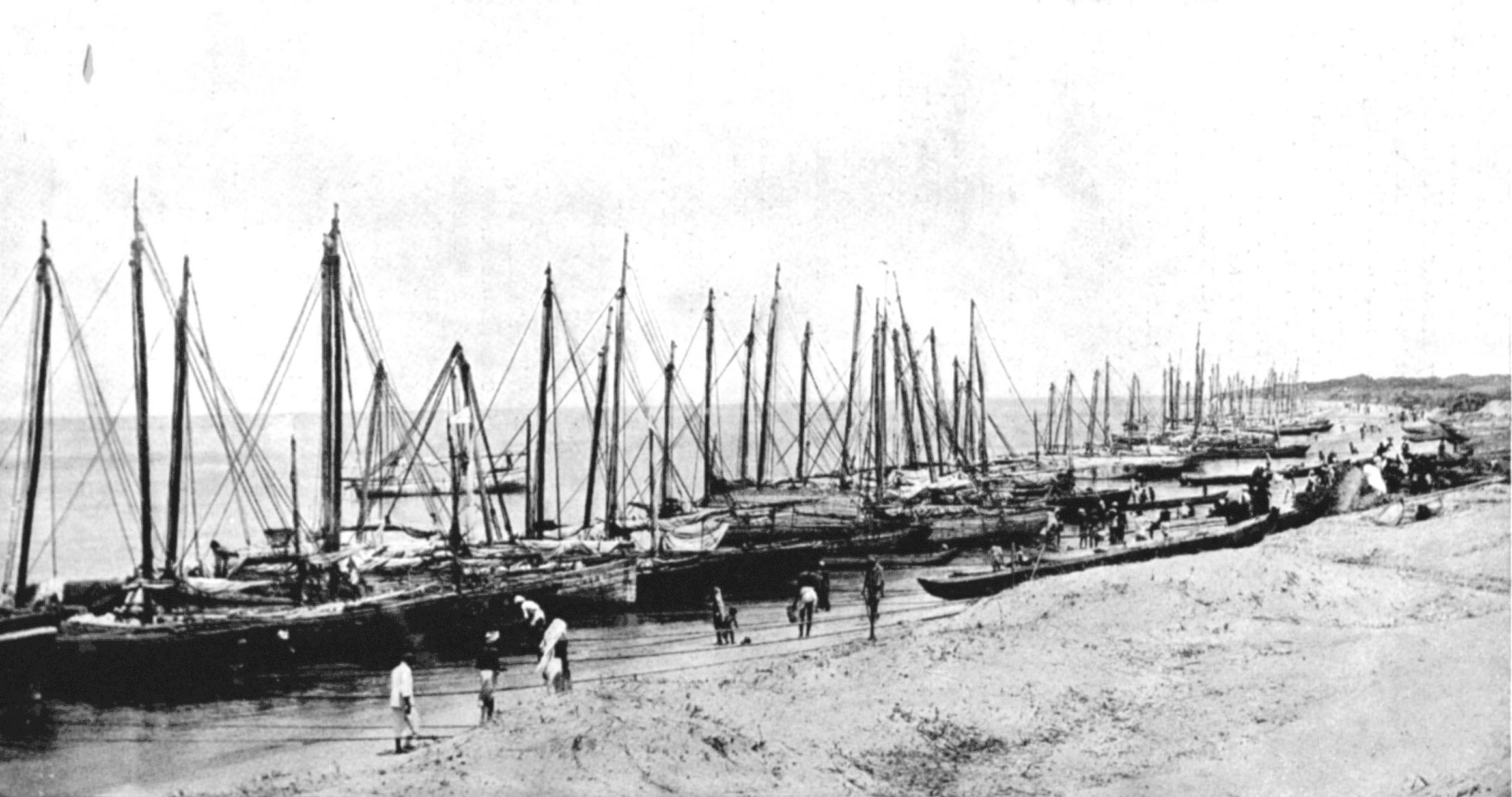
THE PEARL FLEET PREPARING TO START FOR THE PEARL GROUNDS "There is no particular style of vessel specially required in the pearl fishery, and consequently we find a great diversity of rigs, depending largely on the regions from which the divers come : narrow single-masted canoes with an outrigger, square-sterned luggers, large sailing lighters, three-masted canoes, and clumsy doneys. Some of the larger vessels carry 65 men, of whom about half are actual divers, and the average crew of the entire fleet is 30 to 35 men" |
|
| Photo from Dr. Hugh M. Smith |
|
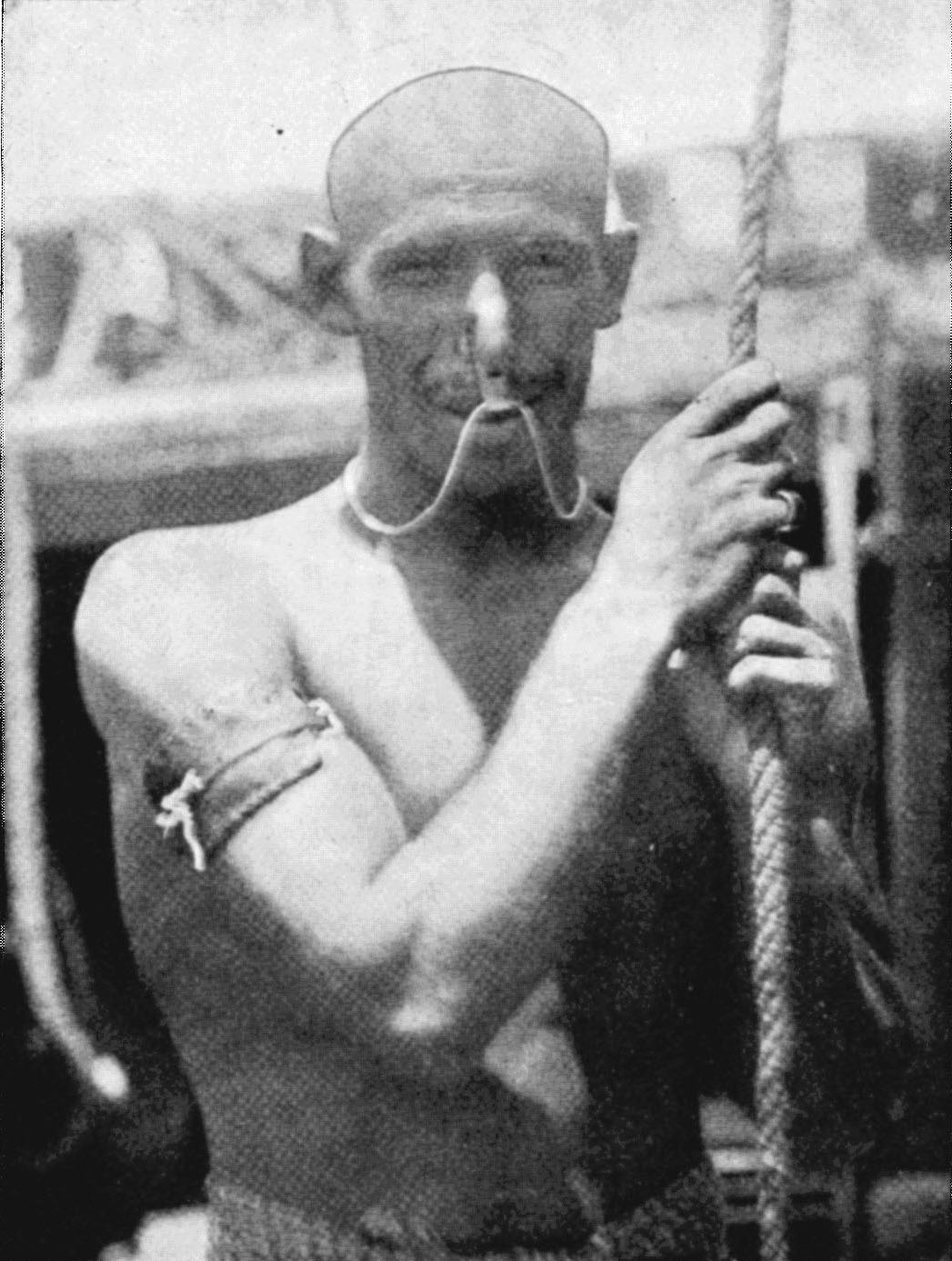
AN ARAB DIVER FROM THE PERSIAN GULF, WITH NOSE-CLIP "A great deal of sentiment has been expended on the pearl-divers and the dangers they have to undergo, particularly from rapacious man-eating sharks. The writers of both poetry and fiction for centuries have played on the feelings of humanity in depicting the perilous life of the divers. As a matter of fact, there is no particular risk or hardship encountered by the Ceylon divers. Year after year, among the 3,000 to 9,000 divers engaged, not a single fatal or serious accident may occur" |
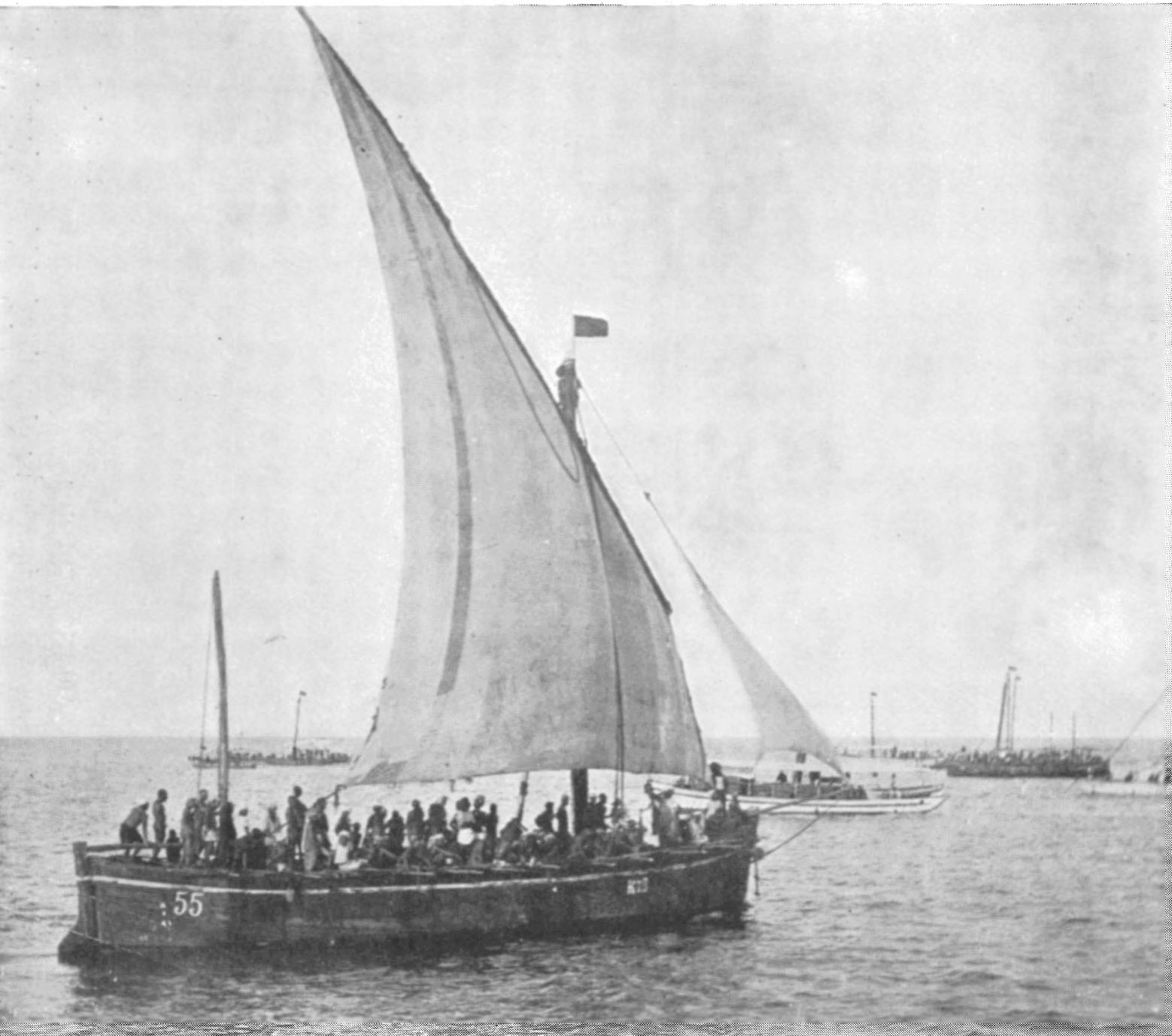
There is no particular style of vessel specially required in the pearl fishery, and consequently we find a great diversity of rigs, depending largely on the regions from which the divers come : narrow single-masted canoes with an outrigger, squaresterned luggers, large sailing lighters, three-ma st ed canoes, and clumsy doneys. Some of the larger vessels carry 65 men, of whom about half are actual divers, and the average crew of the entire fleet is 30 to 35 men.
Owing to the boisterous seas and strong winds of this region, the fishery can be conducted only during a period of a few weeks in March and April, when the northeast monsoon has waned and the southwest monsoon has not begun. The fishery is thus of briefer duration than any other pearl fishery of importance, and is characterized by a strenuousness that is quite foreign to the East.
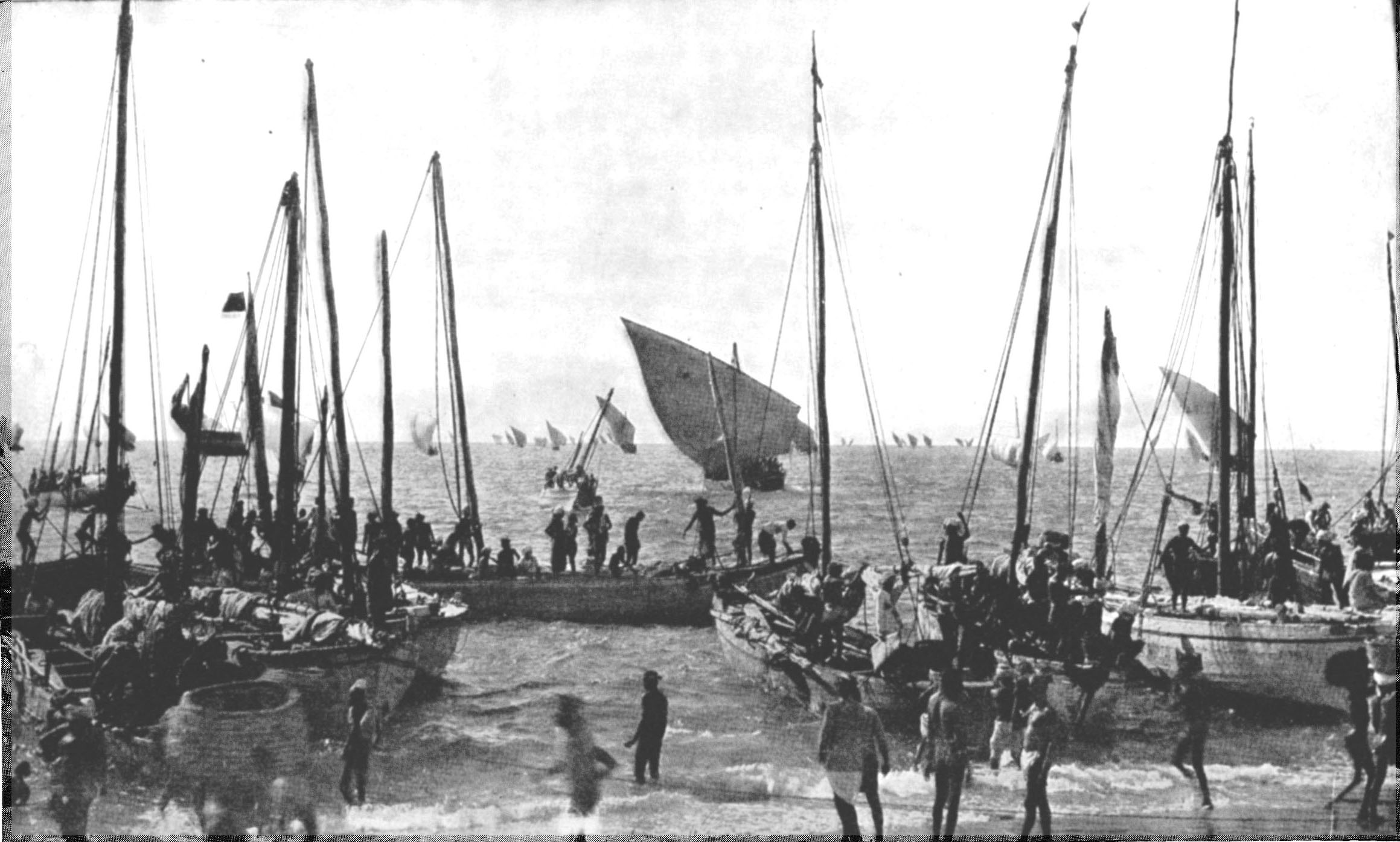
The fishing boats start for the grounds soon after- midnight, so as to be ready for work as soon as daylight comes, about 6 a. m. They take positions about the government vessel moored over the particular ground selected, anchor, and remain actively engaged until noon, when the entire fleet sets sail and starts for the shore. As there is a crowd of pearl merchants eagerly awaiting an opportunity to speculate, there is considerable rivalry among the diving boats in the matter of reaching land and discharging their catch as soon as possible, and consequently one witnesses some wild scenes of excitement when the oysters are being unloaded in the surf and the natives are rushing into the kottus with their catch.
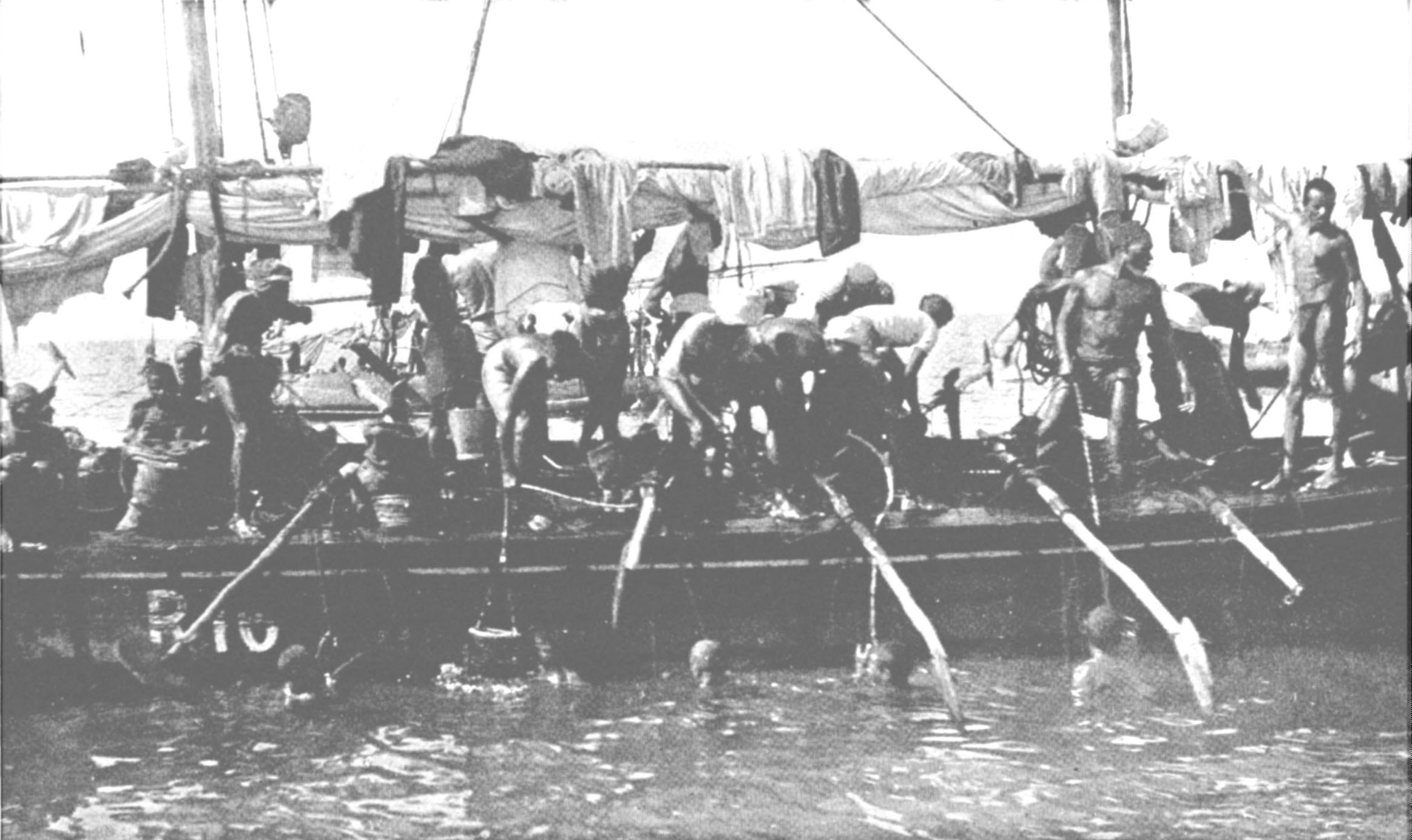
Except for a loin cloth, the divers are naked. Their fingers are covered by flexible leather shields to protect them from the rough corals and shells. In order to facilitate the descent, each diver employs a flat, oval stone, weighing 30 to 50 pounds. The stone is perforated at one end to receive a rope, and close to the stone a kind of stirrup is made in the rope to accommodate the diver's foot. The stone is suspended at a depth of 4 to 5 feet below the surface by means of a cord attached to an outrigger.
|
| Photo by Andree. |
|
ARAB PEARL-DIVERS AT WORK : EACH DIVER HAS A "MANDUCK," OR HELPER, TO
WATCH AND HELP HIM IN AND OUT OF THE WATER "The descents occur at intervals of 5 or 6 minutes. The best divers are careful to dry their bodies thoroughly after each descent and to take sufficient rest. between dives they often smoke a pipe or cigarette, sometimes while in the water just preparatory to a dive." |
|
| Photo by Dr. Hugh M. Smith |
|
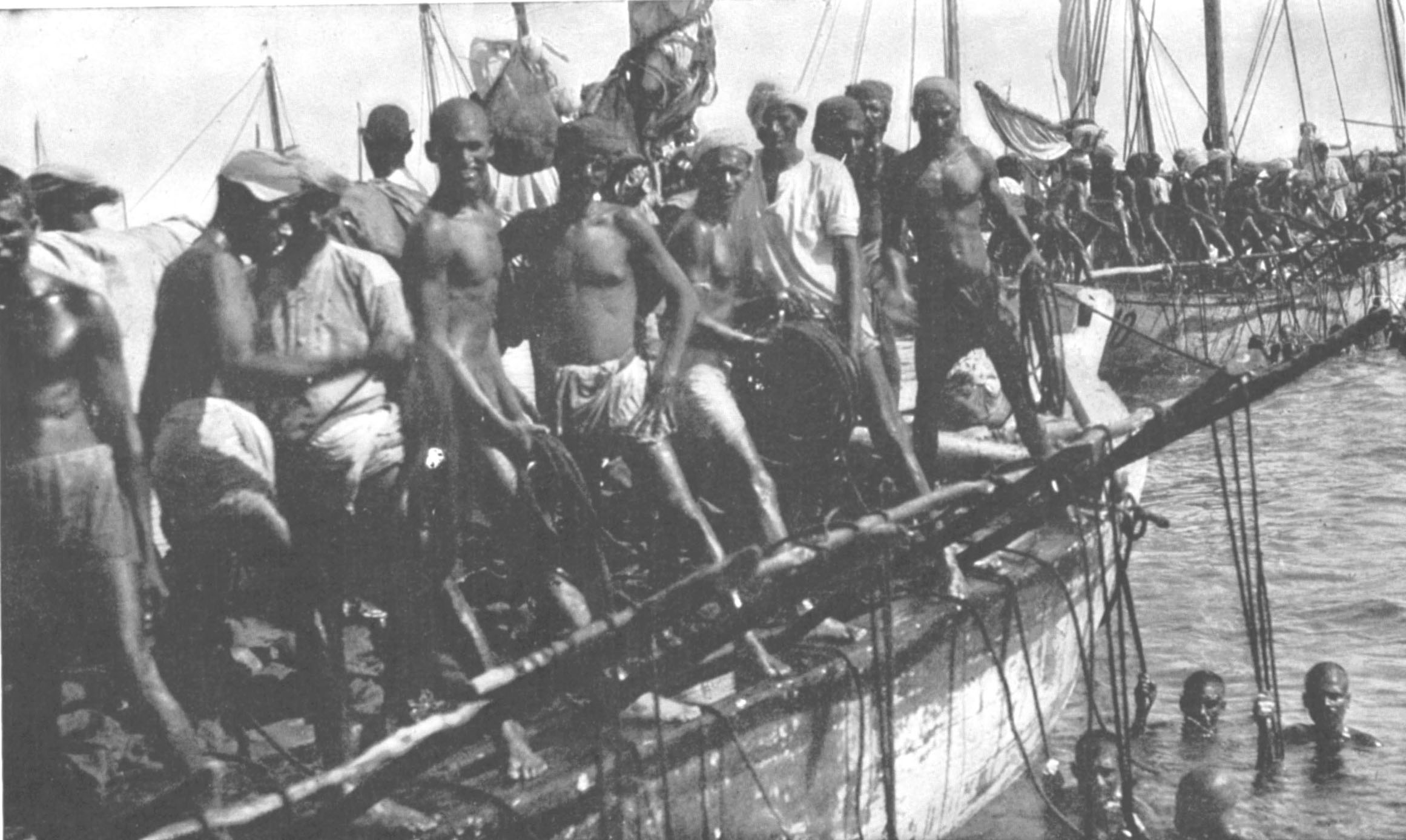
THE PEARLERS LOOK MORE LIKE PIRATICAL CREWS ABOUT TO BOARD A CAPTURED
PRIZE THAN PEACEFUL LABORERS IN A WATERY VINEYARD "On what is regarded as good ground, the average per man per dive is 25 to 35 oysters, but it sometimes rises to 75 or drops to 5 or nothing at the end of a fishery. On one day in 1904 twelve boats, manned exclusively by Arabs, fishing from dawn till noon had an average catch per boat of 22,811 oysters" |
When ready to descend, the diver places one foot on the stone, the other on the rim of a rope basket attached to a rope, inflates his lungs, loosens the slipknot holding the stone, and sinks rapidly to the bottom. There he at once disengages his foot and quickly crawls over the bottom, tearing loose all the oysters he can reach and putting them in the basket. When near the limit of his endurance, he gives a signal with the basket rope and is quickly hauled up by the watchful attendant, or-"manduck," with whom the diver is provided. The helper has meanwhile pulled up and secured the diving stone, and when the basket is hauled in he culls the catch from the miscellaneous refuse that is attached to the oysters.
The divers have learned by experience that they may increase the length of their submergence by making ,a number of deep, forced respiratory efforts before taking the plunge. Most _exaggerated stories have been told and are still current regarding the length of time the divers can remain under water.
The Arab divers wear nose-clasps of flexible horn attached to a cord around their neck, while the divers of other races simply compress their nostrils by hand during the descent. This practice can hardly make any difference in efficiency, and we must conclude that the expertness of the Arabs depends on an aptitude born of long experience.
Their usual time below the surface is 60 to 75 seconds, the normal maximum not exceeding 90 seconds, while the Tamil and Moormen divers range from 35 to 50 or 60 seconds, depending on the depth. There is a well authenticated case in 1887 of an Arab who remained under for 109 seconds in water 7 fathoms deep. The most curious feature of many of the ancient and some of the modern accounts of the pearl fishery is the remarkable ability to remain under water ascribed to the Arabs and others, and it is noteworthy that this ability increases with the remoteness of the time. Percival, whose "Account of the Island of Ceylon" was published in London in 1803, said the usual time for the divers to remain submerged "does not much exceed two minutes, yet there are instances known of divers who could remain four or even five minutes. . . The longest instance ever known was of a diver who came from Anjango in 1797. and who absolutely remained under water full six minutes."
Le Beck, in his "Asiatic Researches,- London, 1798, reports that he saw a diver remain down for seven minutes. Sir Philiberto Vernatti reported to the Royal Society of London in 1667, in response to a special inquiry of the society, that the greatest length of time that pearl-divers in these parts [Ceylon] can continue under water is about a quarter of an hour."
The Dutch anatomist Diemerbroeck, in his "Anatomy of the Human Body" (1672), cites the case of a diver who, under his own observation, used to work under water for half an hour at a time : and Batuta, another man of science. writing of pearl-divers in 1336, said that "some remain down an hour, others two hours, others less."
The number of oysters taken at each dive necessarily varies greatly, depending on the diver, the depth, and the density of the growth. On what is regarded as good ground, the average per man per dive is 25 to 35 ; but it sometimes rises to 75 or drops to 5 or nothing at the end of a fishery. On one day in 1904 twelve boats manned exclusively by Arabs fishing from dawn till noon had an average catch per boat of 22,811 oysters. Usually the men do not like to work on grounds that yield less than 15. or 20 oysters per dive, so the grounds are rarely stripped clean, so far as human agency goes.
|
| Photo by Andree. |
|
THE FIRST TO LEAVE THE BANKS AFTER THE MORNING'S DIVE |
A great deal of sentiment has been expended on the pearl-divers and the dangers they have to undergo, particularly from rapacious man-eating sharks. The writers of both poetry and fiction for centuries have played on the feelings of humanity in depicting the perilous life of the divers. As a matter of fact, there is no particular risk or hardship encountered by the Ceylon divers.
Year after year, among the 3,000 to 9,000 divers engaged, not a single fatal or serious accident may occur. An Englishman, who spent a number of years on the fishing grounds during the entire season, never had a glimpse of a single shark dangerous to man. An English official, who had a life-long experience in the Ceylon pearl fisheries, never knew of a single diver being killed by a shark, and heard of only one case and that extremely doubtful. Still another Englishman, writing in 1887, stated that it was "pretty certain that in the whole course of the Ceylon fisheries only two human beings have fallen victims to. these fierce fishes"
|
| Photo by Andree. |
|
THE FLEET RETURNING FROM THE PEARLING GROUNDS "On the trip from the fishing grounds to the shore the divers and manducks have two to four hours of undisturbed leisure,. in which they improve the opportunity to open oysters and extract and conceal any pearls they may find. This practice is illicit and in violation of the fishery regulations, but it is very difficult to suppress. Guards have sometimes been employed on each vessel, but as they are the friends of the divers and receive only 33 cents a day for their service, there is every reason to believe that they to countenance, but actually to encourage, the fraudulent work" |
The government estimates that at times fully 25 per cent of the catch is illicitly opened ; and, as the largest and most productive oysters are thus weeded out, the government losses in revenue have been considerable. It was computed that in 1905 not less than 15 million oysters were opened by the divers on the homeward trips. These, at the average selling price for the season, were worth $250,000 regardless of the contained pearls. The men resort to all kinds of expedients for -concealing the pearls in order to avoid detection by the shore officials before whom they have to pass.
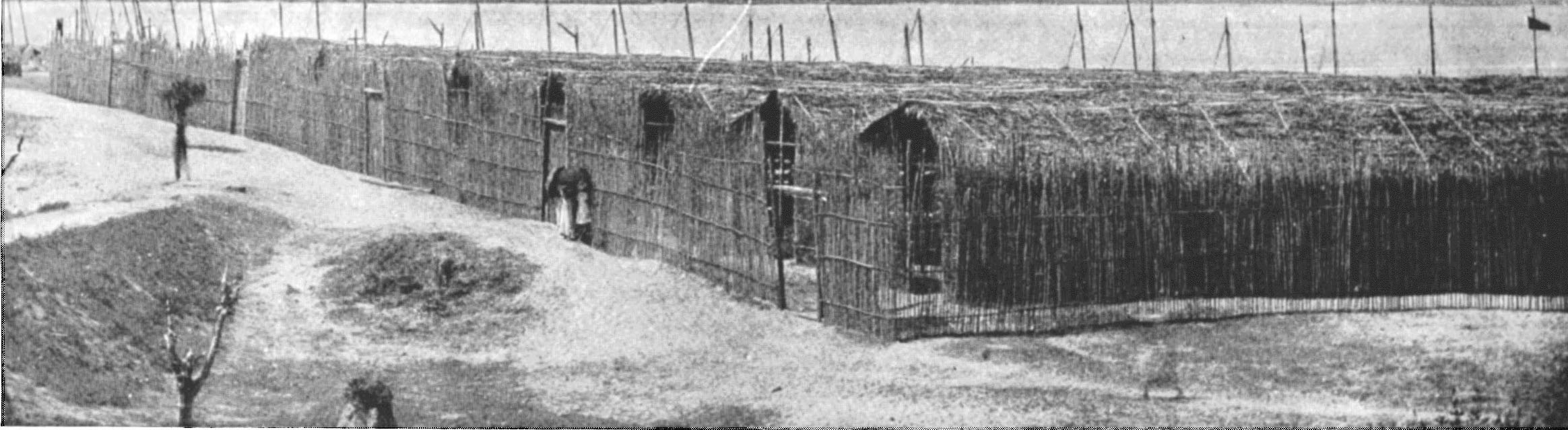
The most important structures in the pearl town are the palisaded enclosures, known as the kottus, in which all of the pearl oysters are deposited and retained until disposed of. The fences are made of bamboo poles, and within the enclosures are bamboo sheds with thatched roofs of palm leaves.
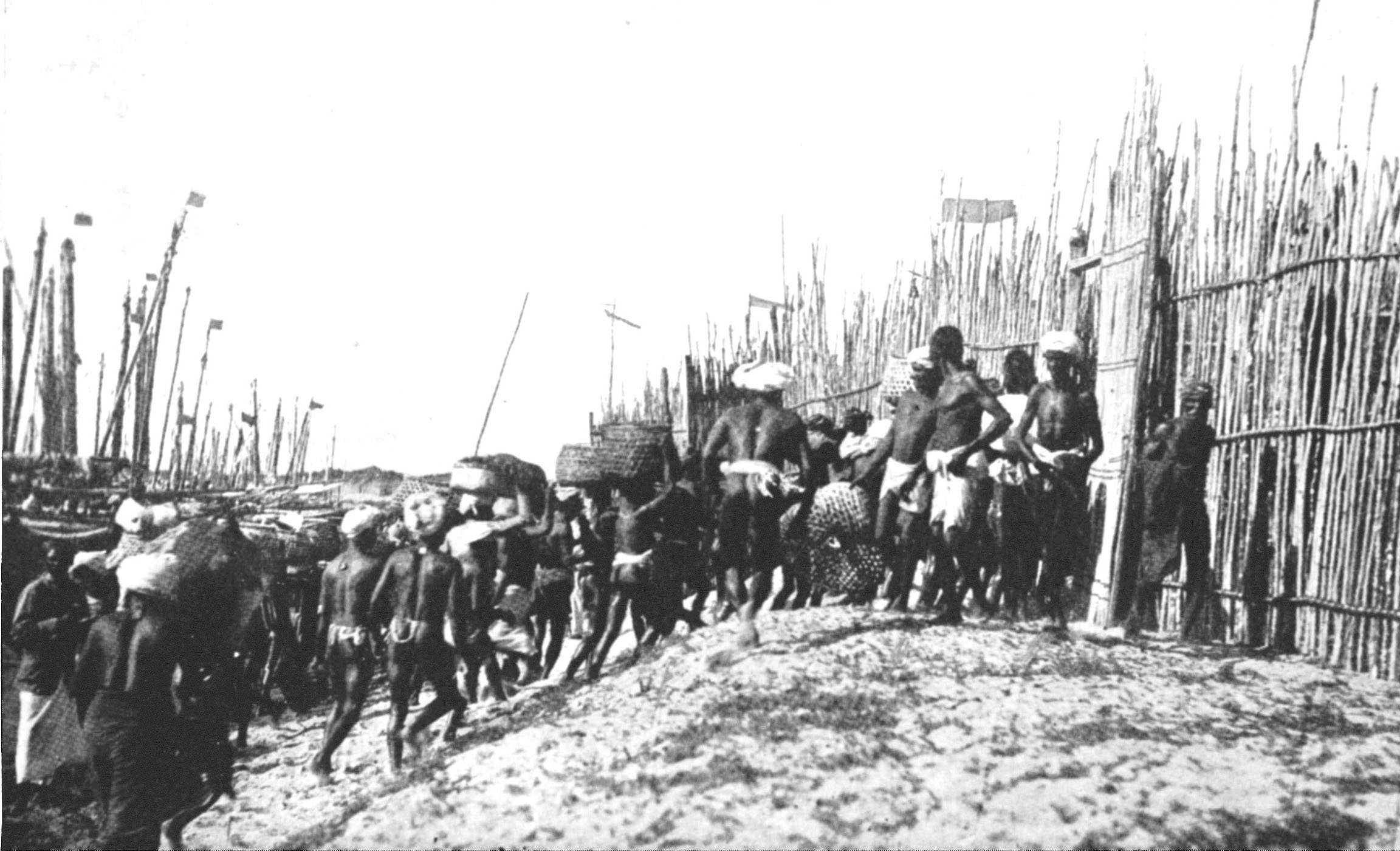
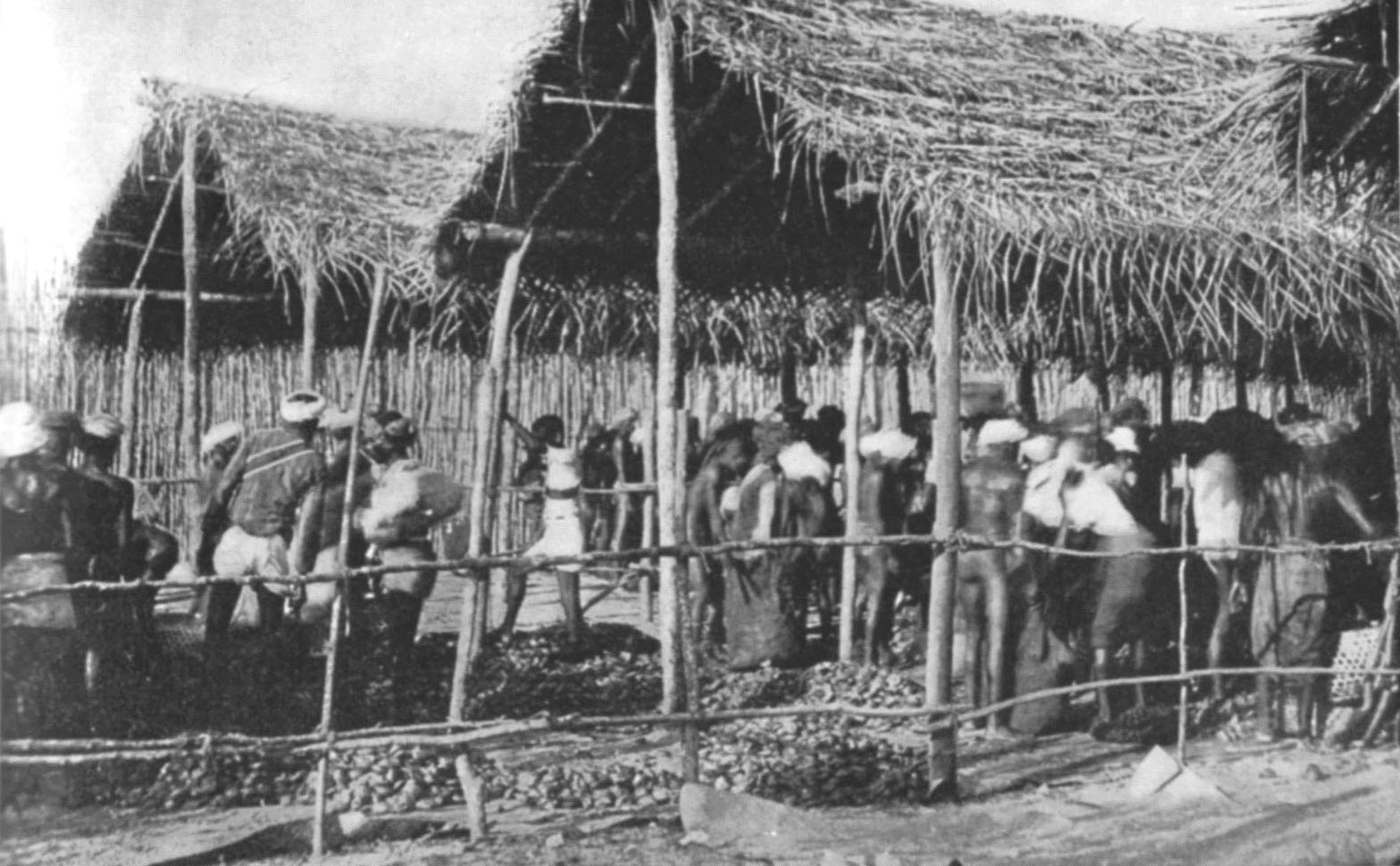
When the boats reach shore the oysters are quickly unloaded and taken at, once to the near-by government kottus, where the catch of each boat is put in a separate compartment. The divers count their catch into three piles containing the same number of oysters, and the government agent then selects the pile that shall go to the crew.
The divers then emerge from the other (land) side of the kottus carrying their precious oysters, and are at once surrounded by a crowd of natives desirous of obtaining oysters in small quantities.
The trade conducted by the divers is of a strictly retail nature, and it sometimes happens that a native man, woman, or child will buy on speculation a dozen or half a dozen oysters, or even a single one. The stock of the divers is usually eagerly sought and quickly bought. After disposing of their catch the divers spend the remainder of the day in eating, resting, bathing, and religious devotions.
The government's share is carefully counted by clerks, and about sunset each day is put up and sold at auction at the court-house by the government agent. The unit of measure is a thousand, and a successful bidder may take one or many thousand at the price offered. During the night the oysters are carefully guarded, and next morning the buyers present their certificates of purchase, pay the price, and take their goods.
The oysters are piled into dugout canoes and covered with matting or else set aside in coarse sacks for 7 to 10 days. Bacterial putrefaction is supplemented by the work of blow-flies and their larvae, and at the end of the period stated the disintegration, decomposition, and digestion of the oysters have progressed so far that there is little left but pearls, shells, slime, and foreign matter adhering to the shells, together with a large volume of maggots. The first step in the cleansing process is the flooding of the canoe to the brim ; then the naked natives, ranged on either side of the vessel, remove the shells, washing and rinsing them and removing any detritus in which a pearl may lodge.
|
| Photo by Andree. |
| THE PEARL OYSTERS BEING CARRIED FROM THE BOATS INTO THE GOVERNMENT KOTTUS TO BE COUNTED AND APPORTIONED |
Eternal vigilance must be exercised by the owners to prevent the theft of pearls, and one of the precautions taken is to forbid the washers to remove their hands from: the water except to drop at their feet the cleansed shells.
The shells having been removed, the canoe is filled with water again and again, and the gurry is kneaded and stirred in order that the lighter filth may be floated off. The water is finally decanted, and the heavier debris containing the pearls is removed with scrupulous care and wrapped in cotton cloth, undergoing a preliminary search for the largest pearls and numerous subsequent examinations in the course of drying.
The dried matter is then sifted and sorted and gone over again and again ; and then, when it would appear that even the dust pearls must all have been extracted, the debris passes for a final search into the hands of women and children, whose sharp eyes and delicate touch enable them to discover an amazingly large quantity of small pearls. The material then remaining is offered for sale and always finds ready buyers.
We can easily imagine the anxiety of the speculators, especially the small plungers, when the washing of their pearl oysters has begun, and we can-readily understand the nervous tension under which they exercise the right to thrust their hands into the gurry and pick out the pearls. Having the scantiest clothing, or none at all, whenever they withdraw pearls from the mass of putrid matter and squirming maggots they may deposit them in the safest and most available receptacle their mouth !
The preliminary government inspection of the oysters on the grounds set apart for the fishery showed pearls present of the average value of about 23. rupees ($7.70) per thousand ; but at the beginning of the fishery there was a marked enhancement in the value of pearls in the world's great markets, and the value increased during the progress of the fishery, so that the speculative prices for the oysters at times soared to $30 and even $40 per thousand, and the average price for the season was $16 to $17, making the first yield of the fishery about $1,365,000, excluding the value of oysters stolen by the natives while on the boats. The prices of pearls in Bombay and Paris warranted the prices paid. in Ceylon for the oysters, and the merchants who sold their holdings made large profits.
In 1906 a record was established, when on one day 309 rupees (over $100) per 1,000 oysters were paid, and in 1907, when the speculation fever attained unusual severity, 70 to 90 rupees were not infrequently bid for oysters that ordinarily would bring only 15 rupees, and the verdict for the season was that the contained pearls did not warrant the prices paid. Then came the financial panic. The demand for pearls in Paris, London, and New York fell off, prices dropped, and the Bombay merchants lost heavily, and several of the leaders committed suicide in consequence.
It is a rather interesting fact that since the government leased the pearling rights to a private syndicate in 1906 there has been no fishery worth mentioning. Notwithstanding this, however, the company, having received the government's proceeds of the fishery during the last year under the old regime, has been able to declare large dividends, and the stockholders have had reason to be well satisfied and can afford to wait awhile for another successful fishery.
|
| Photo by Andree. |
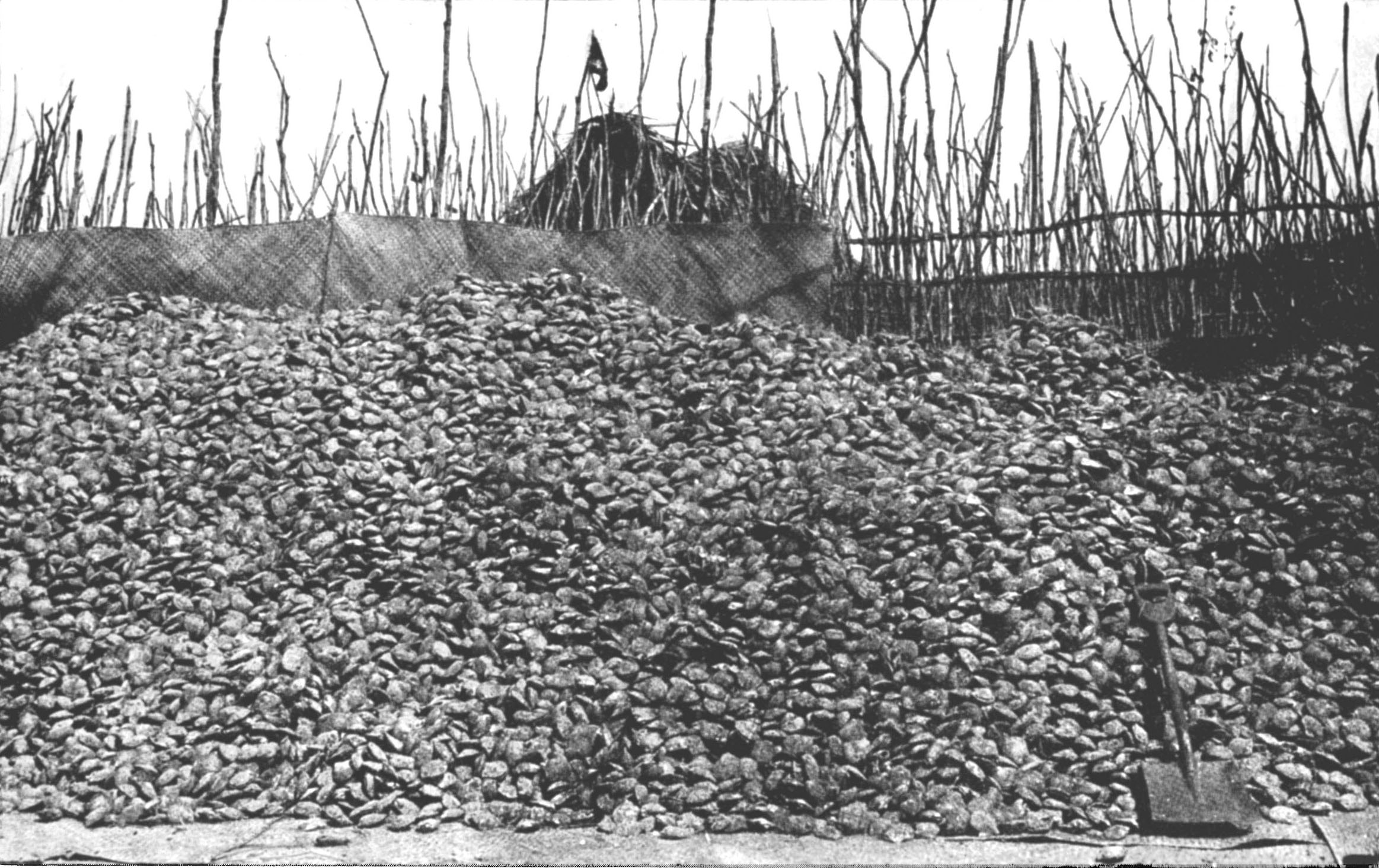
| THE BEST PART OF A MILLION PEARL OYSTERS |
|
| Photo by Andree. |
| THE DIVERS RECEIVING THEIR WAGES IN OYSTERS: THEY FREQUENTLY FIND VERY VALUABLE PEARLS IN THEIR SHARE AND ARE MADE RICH FOR LIFE. |
Recent reports received from Ceylon were quite alarming as to the condition of the grounds. No spat had fallen; there were few adult and young oysters on the grounds, and no fishery was expected for several years.
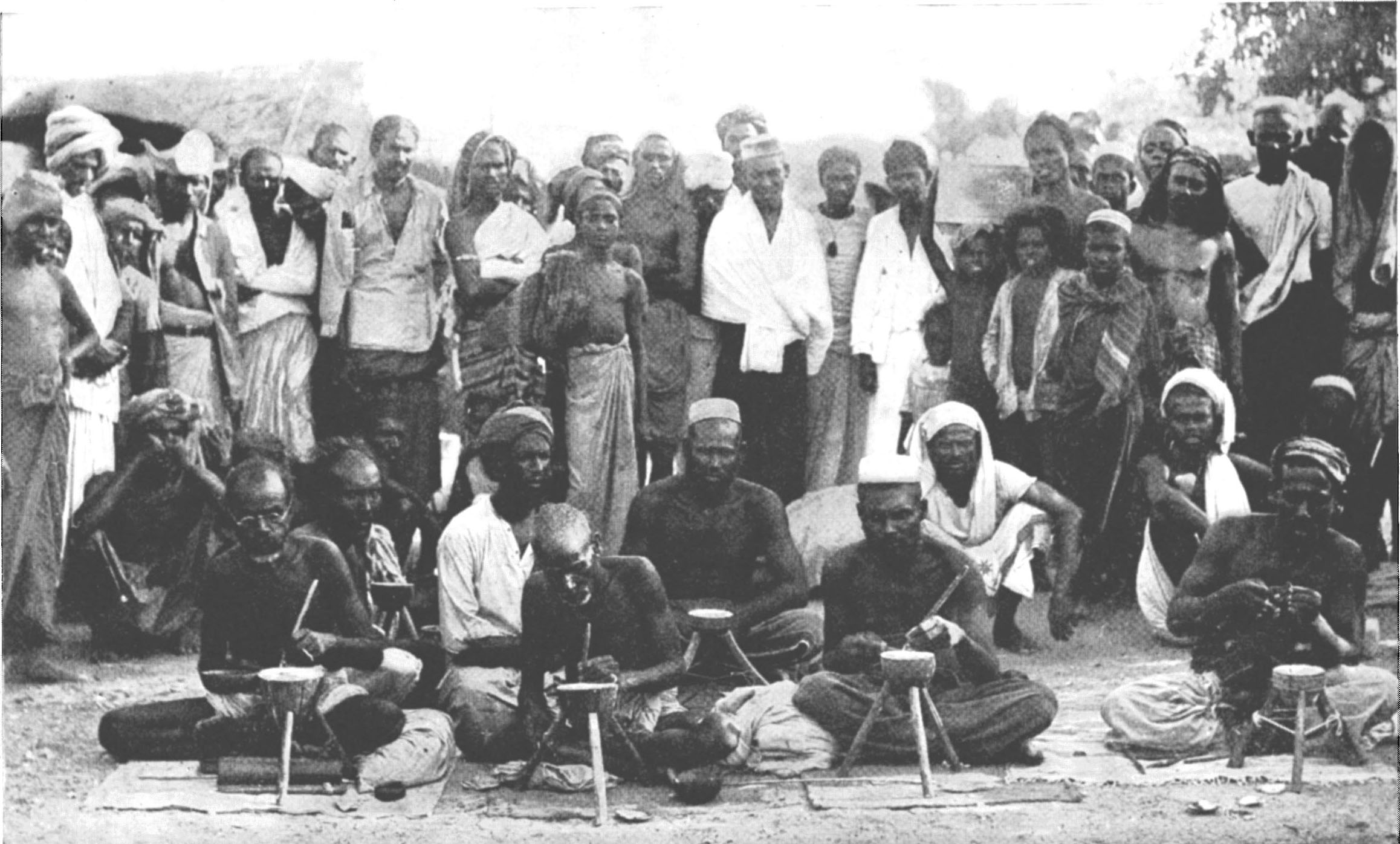
The pearl fakirs sit about the streets at little three-legged wooden work tables, and there drill pearls for stringing; buy and sell defective pearls ; convert bad pearls into good ones, and palm off repaired, plugged, peeled, and doctored pearls on the unsuspecting and unsophisticated. Their principal livelihood is from the handling of blemished pearls.
Sometimes pearl's will exhibit defects that greatly impair their market value ; but there is always a possibility that the blemish may be only "skin deep," and that by peeling off the outer layer or layers of pearly matter the underlying part will be found to be free from defect. On the other hand, pearls may have superficial defects that detract from their value, but are not sufficient to prevent sale at good prices and their use for special purposes ; and such pearls, if peeled in the hope of entirely eliminating their defects, may be rendered worthless by the rapid increase in the size of the defect as the lower layers are uncovered.
|
| Photo by Andree. |
| THE GOVERNMENT STOREHOUSES, OR KOTTUS, WHERE THE OYSTERS ARE SAFEGUARDED AND AUCTIONED OFF |
One can readily see the elements of uncertainty and the lottery possibilities that are here presented to professional fakirs and amateur speculators. To illustrate the uncertainties of pearl faking : I knew of a Tamil laborer who risked his savings of 150 rupees on a blemished pearl, which he forth with proceeded to peel. The removal of each successive layer left the pearl with a larger visible defect, and when the futility of further peeling was impressed on the speculator he had on his hands a pearl that with difficulty was disposed of at 25 rupees.
A little later this same man, still possessed of the speculative fever, had an opportunity to buy for 75 or 100 rupees a pearl with a large discoloration, which possibly involved only the superficial layers. Not wishing to run the risk alone, he induced two others to enter the pool with him. The pearl, subjected to the skillful treatment of a fakir, was soon rid of its defect and ultimately sold for 900 rupees.
Notwithstanding the comparative safety of the diver's vocation, from a very remote period up to a recent date the ignorant and superstitious Indian divers insisted on the presence at each fishery of shark-charmers, whose function it was, for substantial considerations, to keep the sharks away from the individual divers, and who had the power to make sharks bite divers who did not exhibit a proper respect for the conjurers' powers. These impostors appear to have reached the height of their influence in the 13th century, when there was probably one on each diving boat and when their share amounted to fully five per cent of the aggregate take of oysters. Under the Portuguese it was deemed expedient to permit 12 of these fakirs to ply their trade, with diminished privileges and income, and when the British acquired Ceylon the number was reduced to two, who at first were allowed to receive one oyster a day from each diver, but later were paid a regular salary by the British government and were forbidden to exact any tribute from the natives. Finally, after flourishing for at least 600 years, and possibly for 1,000 or more years, the shark-charmers were abolished just 25 years ago .
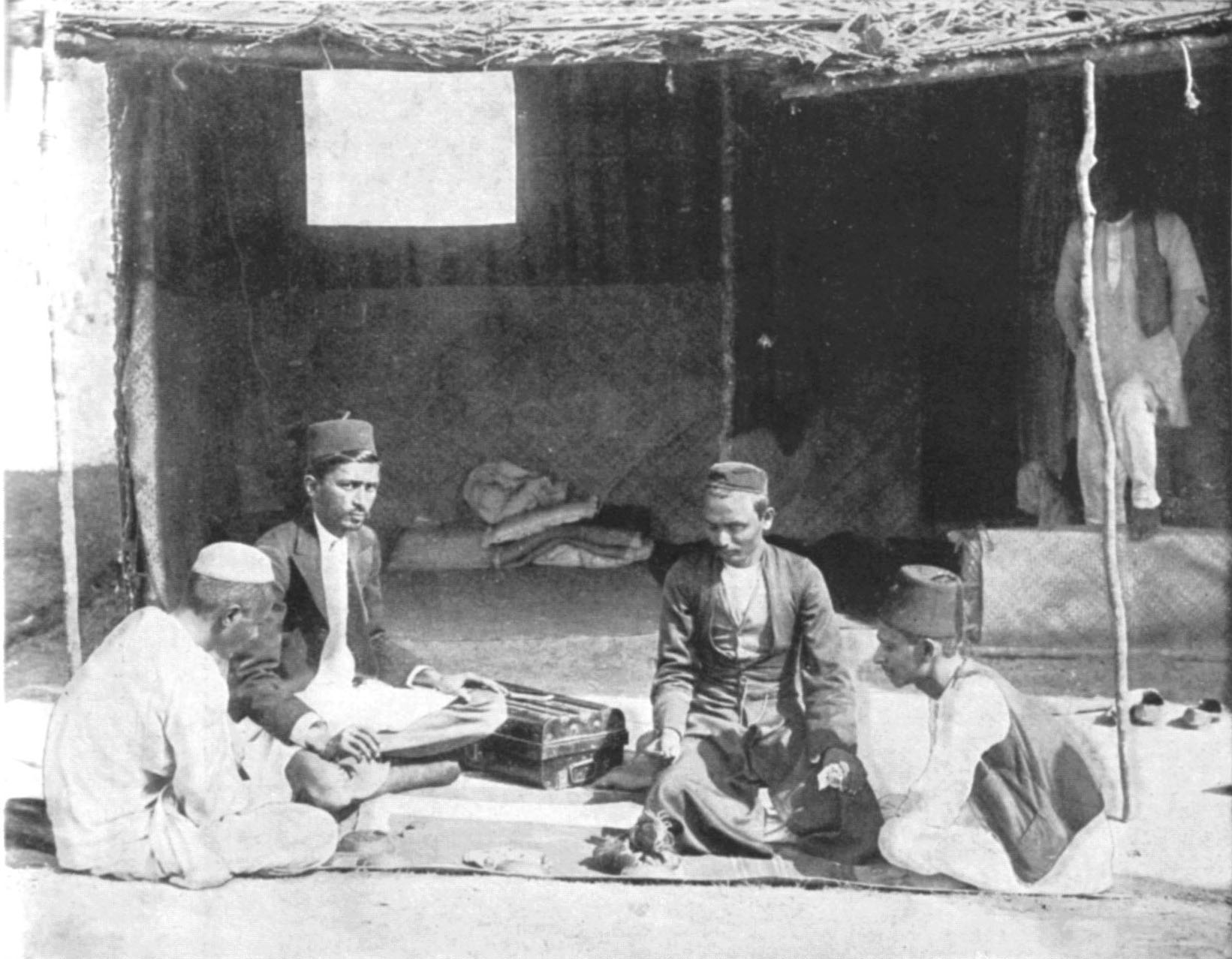
|
| Photo by Andree. |
| PEARL BUYERS : THESE MEN OF MANY RACES AND CREEDS ARE WONDERFULLY EXPERT IN RECOGNIZING AND APPRAISING PEARLS |
The most lavish use of pearls is met with among the Indian rajahs, some of whom, when clad in their full dress, are literally covered with these gems. These pearly possessions often represent the greatest item of wealth of these nabobs, and are usually heirlooms, added to from time to time and rarely disposed of, so that vast accumulations have sometimes occurred.
The pearls of the Ceylon waters are for the most part silvery white in color ; sometimes they are yellowish, creamy, or pinkish. For luster, or "orient," they are surpassed by the pearls of no other part of the world, and for spherical regularity, also, they are unexcelled. Other peculiarities are that their size averages smaller than elsewhere in the world, and that their number exceeds that in any other fishery. Pearls weighing over 10 grains are very uncommon, and by far the larger number weigh less than two grains. Specimens worth $350 at the fishery are rare ; the most valuable pearl found in 1904 sold locally for $830, and the record fishery of 1905 yielded one valued at $4,000.
|
| Photo by Andree. |
|
THE PEARL, FAKIRS These men earn a living by stringing, peeling, and repairing defective pearls. They are very skillful workmen, but frequently dishonest in their dealing |
|
| Photo by Andree. |
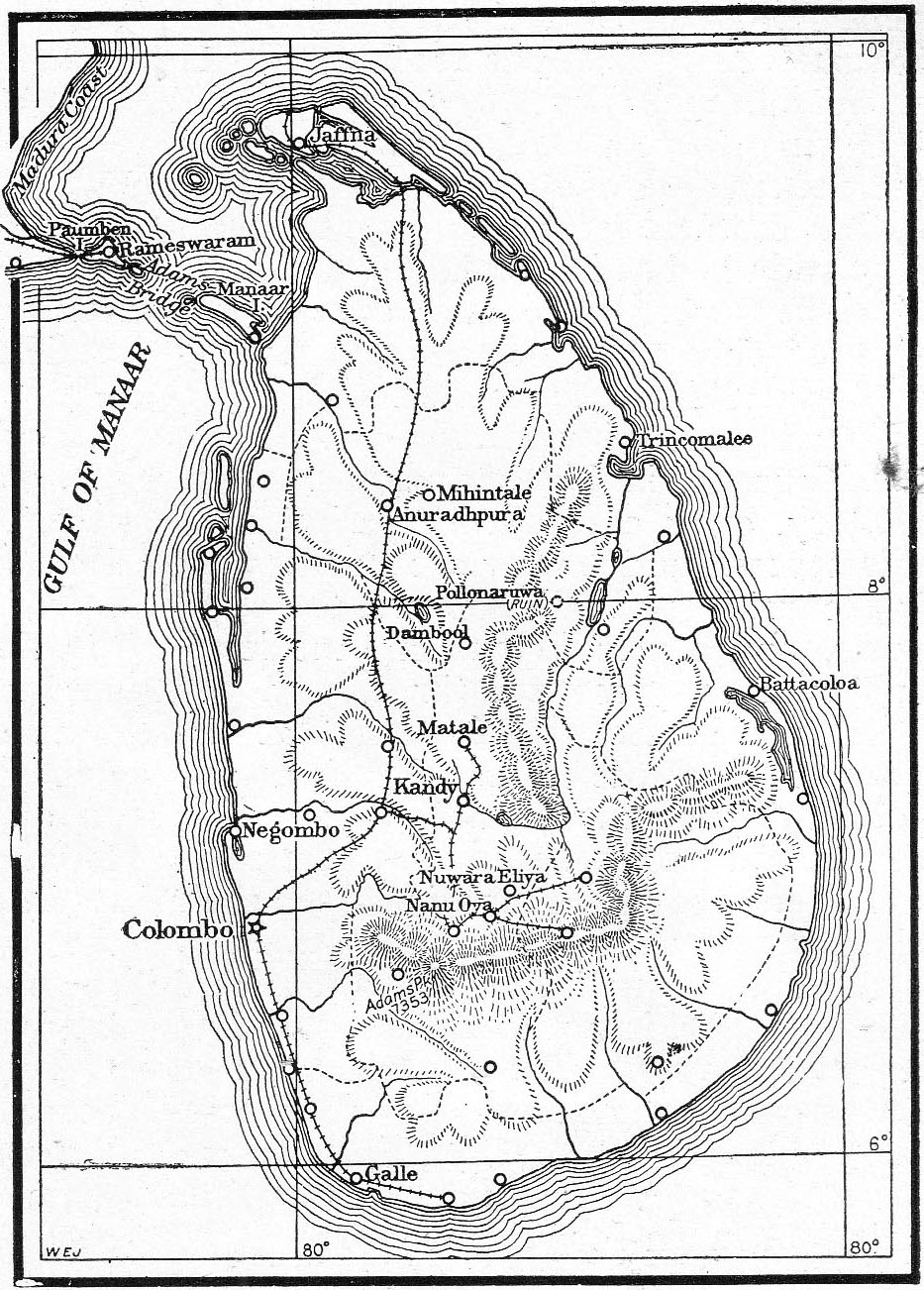
| OUTLINE MAP OF CEYLON |
More seed pearls result from the Ceylon fisheries than from all other parts of the world combined. The most minute, that have no value as pearls, are calcined and sold to the wealthy for chewing with the betel nut. The same use is made of many American fresh - water pearls, for which a market has now been established in Bombay.
Somewhat larger seed pearls, that have no sale outside of Ceylon and India, are placed in the mouths of deceased Hindus of means, replacing the rice grains that are employed for the same purpose by the poorer people.
The larger seed pearls are drilled, strung, and used for ornament. The drilling is done by the most primitive means, and it is a very clever workman who can perforate 40 to 50 pearls in a day with the ancient bow-drill. This will enable us partly to estimate the labor required to drill the 120,000 seed pearls in a necklace, dating from the Louis XVI period, now the property of an American lady. By means of one of the modern mechanical drills, 1,500 pearls may be easily and accurately perforated in a day.
It is interesting to contemplate that in all waters having pearl-bearing mollusks, from the earliest dawn of history down to the present time, much the larger part of the pearl crop has never been harvested and never seen by man, but has been scattered on the floor of the ocean as the oysters have died in the course of nature. This is particularly striking in the case of the pearls of Ceylon because of the brief, almost ephemeral, life of the oysters.
It is not necessary in this article to enter into a discussion of the origin of pearls, but it is not inappropriate that some brief mention thereof be made, because this subject has received special elucidation in Ceylon.
During the first 1,500 years of the present era, and doubtless for many preceding centuries, every theory of pearl formation had as its essential feature the idea that every pearl was originally a drop of dew or rain possibly a tear that gained entrance into the shell of an oyster in one of various ways. Pliny the Younger, in his celebrated Natural History, gives a detailed description of this process, and similar accounts appear in the writings of philosophers, travelers, poets, and others in ancient, medieval, and even early modern times.
It is a noteworthy fact that at the present time the Arab, Persian, and Indian divers quite generally believe that at certain seasons the pearl oysters come to the surface in the morning, open their shells, and suck in or imbibe in some way a dewdrop or raindrop, which, suffused with sunlight, is slowly transformed into a lustrous pearl. The American consul at Aden recently reported that the scarcity of pearls in the Red Sea was ascribed by the Arabs to the fact that little rain had fallen for several years.
We now know that almost any kind of foreign body whether a grain of sand, a bit of mud or shell, a piece of seaweed, or a small animal may by its irritation cause the mollusk to cover it with nacre and make it the nucleus of a pearl. The pearly matter is slowly deposited in definite layers, and the growth of the pearl continues indefinitely.
But if the annual supply of pearls depended on the foreign bodies accidentally gaining entrance into the cavity of the pearl oyster, there would be no great pearl fisheries, and pearls would not be the highly prized, costly gems they are.
It has now been pretty definitely established that the great bulk of the annual pearl crop of the world probably 90 per cent of it represents animal parasites which normally pass a part of their life-cycle within the pearl oysters, and during that period, becoming encapsuled in the tissues of the mollusk, are in time covered with a nacreous coat, owing to the irritation they impart to the oyster. It was not until the middle of the 19th century, however, that the parasitic origin of pearls was proposed and established, and some of the earliest research was addressed to the Ceylon pearl oyster. But it was only during the present century that the true role of the parasite and its life history were satisfactorily cleared up.
It is now known that the minute spherical larvae of various marine worms, but particularly of cestodes, enter the pearl oysters and become more or less embedded in the soft tissues, as many as 40 of these larval worms having been found in one Ceylon pearl oyster. As a result of the irritation caused by a larva, the oyster forms a protecting epithelial sac about the intruder, and then, if the latter dies, its mass is gradually converted into carbonate of lime, pearly nacre is secreted by the contiguous epithelium, and the growth of the pearly mass proceeds with the growth of the shell which is formed in the same way.
Reference has been made to the life-cycle of the parasite. If the larvae do not die, the hosts may be eaten by fishes and the larvae will not find lodgment therein and undergo a certain development. Among the fishes that largely prey on the pearl oysters are the tough-skinned, strong - jawed trigger - fishes. These in turn are eaten by large rays that are common on the pearl-oyster grounds, and in the rays the worms reach their full development and produce young (larvae) that are cast into the water and find lodgment in the oysters.
We are thus prepared to accept the well-known saying of a celebrated. French investigator, that "the most beautiful pearl is in reality only the brilliant sarcophagus of a worm."
See also Hornel Exhibit at Lionel Wendt 2023 January 13th to 16th.